A day to be blessed
After experiencing that sublime concert two evenings ago, yesterday we took a day trip into Staunton, Virginia, to visit the Woodrow Wilson Presidential Library. It isn't that either of us is a big Wilson fan; mostly we didn't know much about him. My (ancient) high school history served up, "Wasn't he the League of Nations president? And World War I?" I didn't know that his first name is actually Thomas--though he suddenly stopped using it when he went into politics, which is interesting--nor that his father was a Presbyterian minister, nor that he is in the top 3 presidents for the number of published books that he authored.
As a middle-class white woman who finds racism deeply wrong and tries to get past the natural tendency to stay closer to those who look like me, I thought they did a good job of openly acknowledging Wilson's deeply racist views during a deeply racist time in America. They did not make apologies nor try to rationalize his views. Wilson was born in the house in Staunton that we visited, the manse that the local church provided for the minister and his faily to live in, and three enslaved individuals were provided along with the manse, a cook, a maid, and sort of an all-around handyman. The docents used the words "enslaved individuals" rather than "slaves," which (I believe, and I might be wrong) offers more dignity to people who were captured against their will or born into this terrible system. Either way, it was not exactly their choice, and the penalty for trying to break out of this dehumanizing and horribly unjust system was huge.
I was much taken by this description of the U.S. as a nation of immigrants. I see here the tension that has continued to exist through the last century, an energy that can be stoked into a wildfire or calmed to a more comforting warmth. The arrival of 14.5 million immigrants is a lot. That would be more than 4% of our current population of around 340 million. And while 4% may not sound like a lot, 14.5 million people needing services to enter and settle makes for a lot of work!
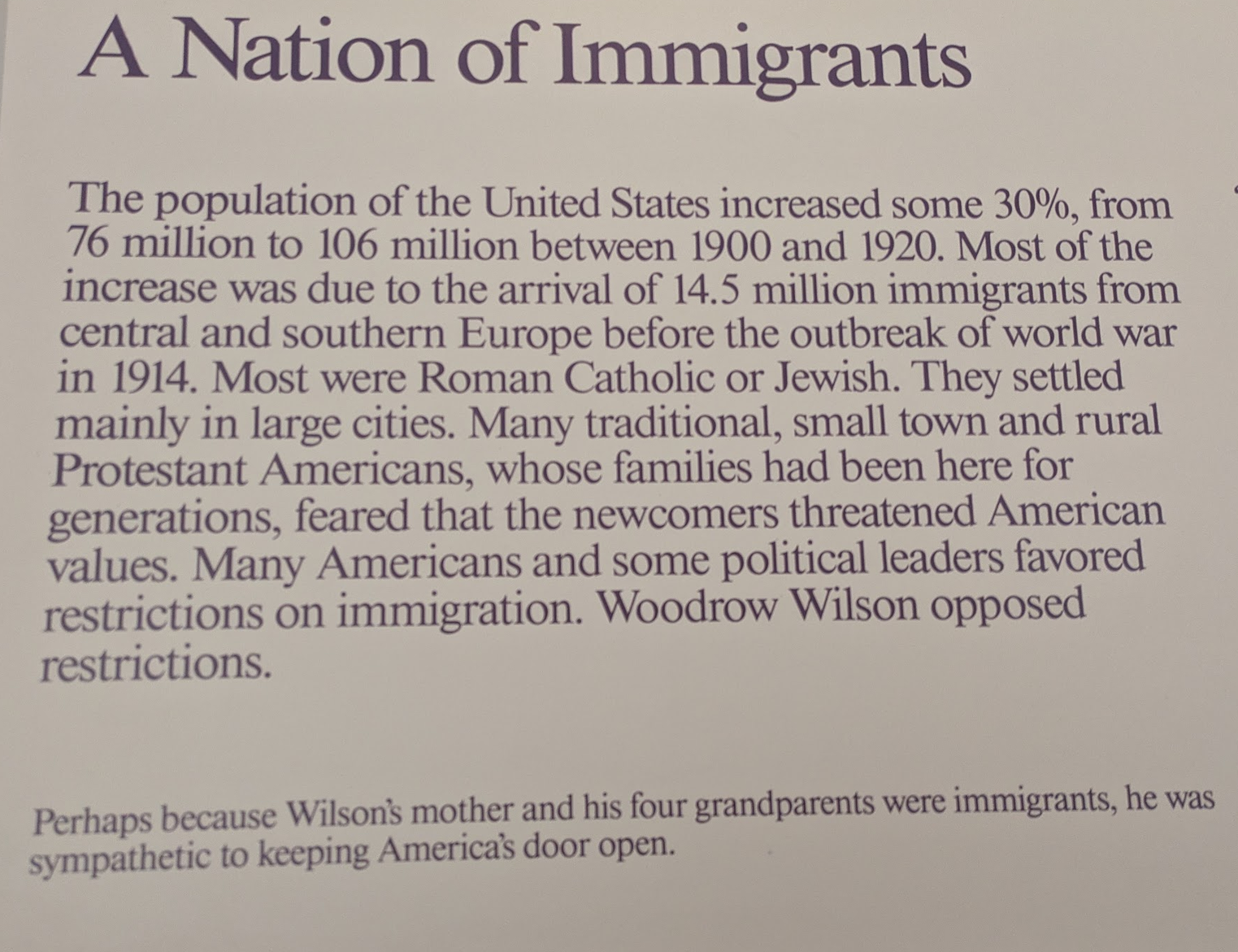
I believe there will always be some natural tension between rural and urban residents, because the two ways of living are so different. When the density of the population changes, the populations have different values and needs. In a rural area, you know all the people who live around you, and you help your neighbor because there simply isn't anyone else who can. In the city, people can be more anonymous, generally minding their own business, and there are services to help people, government services and some provided by religious groups or other NGOs. Whether you know the people who live near you depends entirely on you and on them. And with differences in religious, racial, and cultural makeup, it is easy for mistrust and resentment to grow. Especially when those are encouraged by leaders in industry, pop culture, or politics.
I just stared at this message, reading it over and over. Here is one of the seeds of our current national divide, this split between red and blue, rural urban, catholic and Protestant, Jew and anti-Semite. Not that I know how to fix it, by any means. I think we have to listen to each other, to consider that nearly everyone wants what is good for their community and their country, and to set aside our intersecting identities and instead simply be people together.
Whenever we take overnight road trips, one of our traditions is to find a local pizza shop for one of our meals. Yesterday we asked the lady in the gift shop of the Presidential Library for a recommendation, and she came through amazingly. We visited Luca Pizza in Staunton, and it was simply amazeballs. We shared the "small" Caesar salad and still had enough to bring back to the room for later. The "We ♥︎ Meats" pizza was delicious, not to mention adorable, given itty-bitty cupped pepperoni slices about the size of your fingertip!
We drove on the Blue Ridge Parkway and some other more "backcountry" roads. Even with almost all of the leaves fallen, the scenery was glorious. I write this journal post sitting in the nook I mentioned yesterday, as chipmunks scamper and climb the trees outside our window. We may head to the café again, possibly with a board game or two. And I know I'll enjoy doing some nothing after lunch again.
It is a blessing. The library and museum were a blessing, and continue to bless my heart with discomfort. The pizza was a blessing of hospitality, as is the resort. And doing the nothing, that is the most important blessing I need right now.
How are you being blessed today? What blessing are you bringing?